Herta Müller was the winner of the Nobel Prize for Literature in 2009. I had never heard of her and finally found one of her books in the library. Writing in German, she is a Romanian woman of German descent. In this book, The Passport, she writes about the stifling hopelessness of people living in a small village under Ceausescu's dictatorship. She writes in a sparse language, hauntingly beautiful; the sentences are just simple statements, they are all short and factual and display the oppression suffered by the people.
I virtually forced myself to read this book very slowly, sentence by sentence, almost word by word, and then a surrealistic picture formed in my head. Light is thrown up here and there and illuminates the existing grayness and blackness. It is a very odd but beautiful and poetic reading experience about village life dominated by the wish to escape and to migrate. To achieve permission to do so and to obtain a passport, the villagers try many things, mostly under the cover of the night. The village miller tries to bribe the mayor by transporting flour sacks on his bicycle, and he fails; the wives or daughters might be sent to the village officials and, yes, also to the local priest who takes fullest advantage of the situation "trying to look for the missing birth certificates under the cover of the mattress of the iron bed." It is the horrors of totalitarianism told in the lone voice of village life in a forgotten region. The Passport is a very quiet book allowing the shaping of word pictures in your mind. Unforgettable.
Thursday, October 21, 2010
Friday, October 15, 2010
Reading matters
Oh, all the places one goes to learn a few new things every day — the books, the newspapers, the magazines, the TV, the videos on the internet, or just talking to somebody or listening to the radio. Again and again one realizes how little one knows about the world, There is so much time and still it's never seems enough to suck up the endless stream of information.
The in the UK published GRANTA comes out on a quarterly basis with stories, poems and photography by various authors from around the world who always provide a new point of view. They have a knack of finding fresh and interesting writers, and many of these writers who have appeared first in GRANTA are now well known here. The latest funky looking copy of GRANTA has just arrived on my doorsteps, and this time the issue had a very different feel. As always it is completely devoted to one subject only, in this case it is PAKISTAN. The cover was commissioned by a Karachi-based artist who normally paints trucks and other vehicles in wild beautiful colors. Once I saw a movie that took place in Pakistan and I noticed that all the trucks and trains were painted in these intense colors. The trucks for instance might be dilapidated, old, overloaded and appear dangerous to maneuver around, but they are attractively decorated. And so it is with the new November issue of Granta, the high gloss cover shows the biggest splash of colors. Every article brings Pakistan to life, the different regions, the different cultures (with a plural), the traditions and religions (although it is now mainly Islamic), the tribes, the wars, the leaders, the corruption, the castes. This country is filled with 200 million people speaking nearly sixty languages and brought into nationhood under the auspices of a single religion, Pakistan is divided and destabilized with ongoing conflicts in Iran, Afghanistan and Kashmir. It is a country of jihadists and anti-Americanism. All 18 stories are seen from varioust angles, and almost all are written by men. The authors either live in the cities, in the country, on the coast, or they are Pakistani living in America, or England. All the writers were new to me except one, Moshin Hamid whose book "A Reluctant Fundamentalist" I had just finished. All the writing is fine and a great mix of reportage, fiction, poetry, nostalgia. I could not stop reading the issue non-stop.
My favorite was the first piece, Leila in the Wilderness, a fable to me. A long piece about two star-crossed lovers, Leila and Qes, and it dramatizes the age-old prejudices toward the birth of girl babies and how this is still surviving in Pakistan. The shortest story in the collection was Mohsin Hamid's "A Beheading"; it was startling and made a strong point on how it is to try to live and work under a repressive intolerant regime. All stories are varied, and each is good. Arithmetic on the Frontier introduces the Pashtun machismo. They live in the North West Frontier where hospitality is inevitable to friend and foe, but tribesmen old and young all brandish their Kalashnikovs. They seem to be smiling and then the fire starts. Written by a Manchester Guardian correspondent who accompanies a civil servant, Jasmal Kawal, and his body guard through the country. The astonishing fact is that Jasmal is all, a lawyer and chieftain, a landlord and warlord. Murder and fighting are constant preoccupations in the Pashtun territories. Besides hospitality, the second requirement is to observe Pashtunvali, the honor code of conduct. Everything must be revenged and nothing is ever forgotten: a murdered relative, a philandering wife, or maybe just a casual insult, A profusion of blood feuds take place non-stop. It is a wild story and completely incomprehensible to my mind.
And so it goes on. How can the Western World lead by the US ever to intrude successfully in such a big muddle and change things that have not been changed for centuries? I quote a remark from the book by a man interviewed by the author in the story of The Trials of Faisal Shazad: "... If you train American-born guys, spend a lot of money teaching Arabic, the culture, the most they get, even after all that, is 30 per cent".
Saturday, October 9, 2010
Tina Bausch Dancing Theater
Finally we made it again to the BAM — this beautiful old and handsome theater in Brooklyn, exciting and enchanting. As part of the New Wave Festival they performed Tina Bausch's VOLLMOND (FULL MOON). New Wave always promises to be exciting and spectacular, and this of course was no exception. Non-stop dancing steps were fueled by non-stop energy in a one piece program interrupted by an intermission.
The constant and brilliant footwork reminded me of our life as human beings with all our weaknesses, our strength and the absurdity of all of it. Non-stop we go. One is pinned to the seat and VOLLMOND triggered thoughts of the moon and its myth, its relationship to the tides and the waters and maybe also to our sometimes bizarre behavior during the time of a full moon.
It was artistic and spellbinding; the stage scene was just a huge huge rock crossing over a river, a piece of water, real water and a lot! Nothing else. Dancers appeared mostly in pairs; the men were strong, silly, playful and the female dancers whirled around strong and feminine when they interacted with the men. They walked over the rock, danced on the rock, played with the water, swirled buckets with water around creating a symphony of water, and yes they all also swam in it. All was underlined with the most beautiful music, very haunting. Tiny little stories were acted out and made you laugh out loud at times. Spoken utterances consisted just of a word or a sentence: sometimes like a cry for help, or a dry comment. One could not help smiling while listening to the profoundness of it all — or you could cry about the sadness. It seemed that everybody in the audience was spellbound, and a huge applause arose at the end. We all became alive again.
Tina Bausch died in 2009; this was her last creation, just finished before she was diagnosed with cancer and then she died nine days later.
Tuesday, October 5, 2010
Tomato time in Massachusetts
The summer is unraveling all at once. No kidding, it's over! Here is a short retrospective about our visit to Erik and Mary in Massachusetts — and perfect summer days. They had moved into this old huge farm house a couple of years ago, and it looks lovely but oh boy it must be cold there in winter. But in summer, oh summer, it has a picture book quality. When we went this time it was for lots of talking, beautiful eating and swimming in what they called a "swimming hole" deep in the woods, at a point where two rivers meet. One swims through rocks, the water is black but clean and cold. At least to me this was a high point — the whole quality about it. The posted pictures speak for themselves, and in the midst of winter I will look at them again! Looking forward to the next summer. Yes.
Monday, October 4, 2010
Missed the beach this year? Yes!
This summer has just zoomed by, zzzz... Of course I am lucky I had the pool and I was able to swim a lot. But the ocean is different! Finally last week we made it to Jones Beach, after the Season it was, a wonderful warm day on September 26. And even the water was still warm, no life guards to be seen, and there were some frolickers and swimmers. Yesterday just a week later it had turned seasonably colder and instead of going into NY we drove to Island Beach State Park, located off the NJ coast, on a long sliver of an island (10 miles long). A spectacular place and in summer it is apparently drawing immense crowds of people — a money maker for the State.
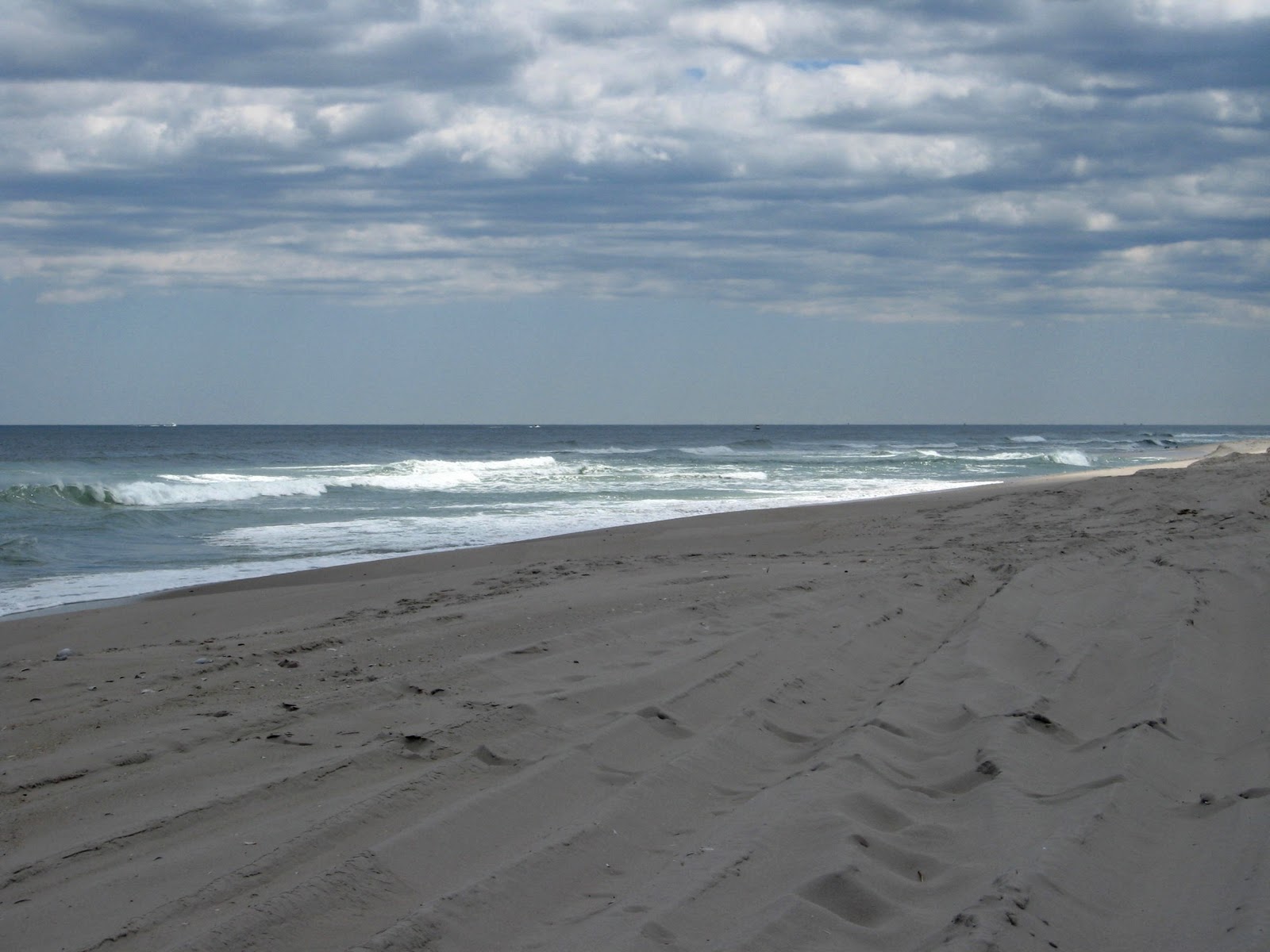
Anyway when we went there yesterday no people to seen, it was completely empty, and I walked on this never ending beach along miles of sand dunes on this very rainy and stormy day. The waves were magnificent, the grayness beautiful and wherever you looked plants, thickets, bushes, flowers and and here and there an osprey colony's nest (empty now of course). This narrow barrier island stretches on and on and Henry Hudson sailed by on his Half Moon and first described the Jersey shore. I found also a large expanse of heather and grew very excited about it; but this heather blooms yellow in Spring for one week only (and is not of purple color blooming in August as it does in Northern Germany). The plants look a bit the same, but this is where the similarity ends except for their name. We call it Heide and the translation is Heather.
I was able to pick a few milk weed pods with seeds which apparently entice Monarch butterflies to put there eggs on it. Will try to grow the milk weed on my terrace on the 21st floor in a pot and will find some Admiral larvae on the internet; and maybe, maybe i will have a colony of Monarch butterflies in the future. I thought they were all distinct since I never saw them anymore. Let's see. I hope I will not forget to do this all in Spring. Picked some Golden Rod plants with roots and will grow these also in a pot outside. Learned that Monarchs like Golden Rods. What a place. Will never forget it.
Inched into the ocean, surprisingly not icy at all, but I was pitch wet up to my hips after a while, and it rained again. Driving back past rows and rows of boarded up summer houses we looked for an open restaurant, was not easy, and finally ended up at Crab's Law, recommended by a guy in a bar. What a memorable meal I had, Seafood Newburg perfectly cooked with Sherry, or whatever "spirit" belongs into it. Was suddenly remembering that in Hamburg we would drink a "Grog" on a cold day to warm you up and I asked them to make one for me (a shot of rum and hot water in a glass, skip the sugar) and it worked alright. My face is still burning today from all that wind and rain.
The pictures from the internet. My small camera broke and I did not dare take along the "real" camera. In reality, the beach was grayer and longer, more mysterious and one of a kind, the sky was darker, wilder, more menacing. But still everything was endlessly beautiful.
These were great hours and I feel fully energized again. All it takes is an ocean.
Wednesday, August 18, 2010
A trip to Bard College and more
It is already over two weeks ago that we decided to buy tickets for a performance by Oedoen von Hovath's "Judgment Day" and the play does not leave my mind. So it's better to write it all quickly down. I was familiar with this author, Jay was not, but I only knew him from my school education and most probably I saw also a play or two in the theaters in Hamburg. I also remember that I did not appreciate von Hovath a lot then and found him complicated and always hard to decipher. But anyway, I was willing to try it again and off we went. I chose a motel in Kingston, NY — a town which I had bypassed many many times on our various Catkills adventures for hiking or skiings. This time though it was the middle of the summer and Kingston was a great surprise to me, an old town consisting of two parts. The older part is situated at the Hudson and named Rondout. I fell in love with the old houses, the old marina, everything there had the slight misfortune of having been abandoned a good while ago. But there were tries again to lift the town of its depression — new lovely restaurants at the river have sprung up, galleries, stores displaying sharp looking fashions, real old houses with fresh paint, and a certain trendiness has suddenly appeared among the shabbiness. How great it was to walk alongside the Hudson and we immediately scheduled a Hudson cruise for the next day, a trip three hours long, peeking at many light houses, at all the old mansions and the splendor of the Catskills. The Vanderbilt mansion impressed me the most with its 79 rooms, only to be lived in for two weeks per year. Well! Kingston (the new part) was rather old also and had these lovely roofed sidewalks uptown with a wild menagerie of bookstores, galleries, pawn shops, and restaurants of course. A nice discovery of a town that I had by-passed so many times before and never paid any attention to.
Saturday night it was off to Bard College at Annandale-on-Hudson where the play JUDGEMENT DAY was staged at Gehrig's Fischer Hall, an incredible steel covered and spectacular modern building sitting in the middle of the lush and green scenery of the Catskill mountains. Seating in the theater was arranged around the movable stage and on account of this everybody had good seats and got fine close-ups of the actors. The stage setting was modern and simple. The story took place at a small town train station and the focus is on the unhappily married station master, Thomas, who is distracted for a moment by a young woman and seconds later 18 people are dead. The townspeople want to find the guilty party of course, there is lots of finger pointing and everybody gets mixed up into the malicious situation. The perfect station master cannot face the situation and falls apart; the woman he flirted with cannot silence her guilty feelings. And the pointed finger remains up in the air to the very end. And this air is full of chill and not only because of the horrible disaster, but also of the time in the thirties; loud mouthed Nazi officers in their brown uniforms march around; the good town folks and the horrible disaster mix up the question where guilt starts and how it possibly can be all loaded on one single person.
Monday, August 9, 2010
Subscribe to:
Posts (Atom)